AI Prior Auth Assistant
Build complete, payer-ready prior authorization requests faster. Reduce avoidable denials and keep procedures moving.
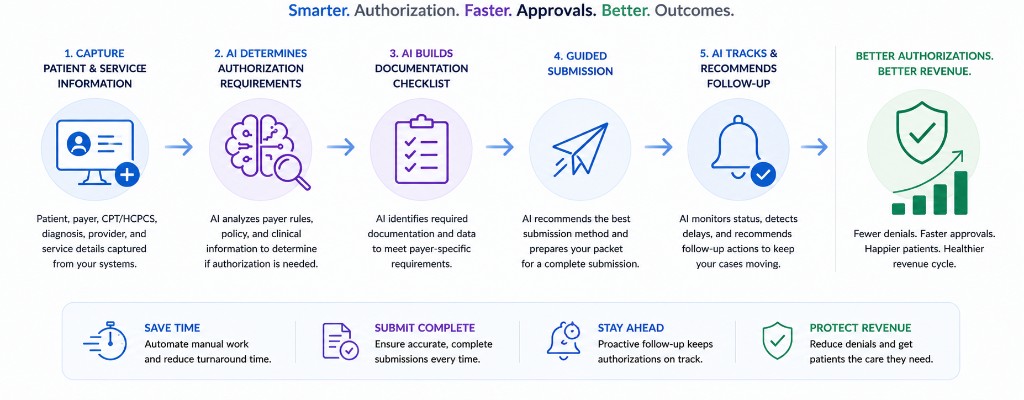
How it works
Prior authorization is often delayed because teams must search payer rules, gather clinical documentation, complete payer-specific forms, and follow up across portals, calls, faxes, and clearinghouse workflows. AI Prior Auth Assistant helps organize that work into a clear, submission-ready workflow so your team knows what requires authorization, what documentation is missing, what is ready to submit, and what needs follow-up.
What AI Prior Auth Assistant Does
Determines authorization need
AI reviews patient, payer, plan, CPT/HCPCS, diagnosis, provider, and location data to identify whether prior authorization is likely required.
Identifies required documentation
The assistant creates a payer-specific documentation checklist so staff know what clinical or administrative information is needed before submission.
Guides the submission workflow
The system recommends the right submission path, such as portal, API, EDI, fax, or existing payer workflow, and helps prepare a complete packet.
Tracks status and follow-up
AI monitors submitted cases, identifies delays, and recommends follow-up actions so authorizations do not stall before the service date.
Works With Your Current Workflow
Your team does not need to replace its EMR, practice management system, clearinghouse, or payer portals. PriorAuthSpace can start with the data you already have, including appointment exports, order data, patient demographics, insurance information, CPT/HCPCS codes, diagnosis codes, clinical documentation, spreadsheets, EDI files, or secure uploads.
If a direct connection is preferred, we connect to your system of record at no additional integration cost. We handle the intake, mapping, and setup so your team can keep working inside its current process while PriorAuthSpace adds an AI layer around it.


Why AI Helps
Prior authorization rules are fragmented across payers, plans, procedures, locations, and submission channels. AI helps by reading and organizing that complexity faster than a manual process can. Instead of asking staff to interpret payer rules from scratch, the assistant turns available data into recommended next steps.
- Find requirements faster
AI helps determine whether authorization is likely required based on payer, plan, service, diagnosis, and location. - Prepare cleaner submissions
AI identifies missing documentation before the case is submitted. - Prevent authorization delays
AI tracks status, detects stalled cases, and recommends follow-up.
Tangible financial outcomes
-
Reduced manual work. Lower the time staff spend checking payer portals, searching policies, gathering documentation, and following up manually.
-
Faster authorization turnaround. Move cases from requirement check to submission-ready status faster, especially for high-volume specialties.
-
Fewer authorization-related denials. Reduce denials caused by missing authorizations, incomplete documentation, late submissions, or missed follow-up.
-
Better revenue cycle predictability. Help scheduled services move forward with fewer last-minute delays, reschedules, write-offs, and avoidable payment issues.
Potential impact areas include prior auth processing time, follow-up workload, authorization-related denial rate, delayed service volume, and staff productivity.
Best Fit for High-Volume Prior Auth Work
- Imaging
- Orthopedics
- Cardiology
- Gastroenterology
- Oncology
- Pain management
- Neurology
- Specialty medications
- DME
- Hospital outpatient services
- Rheumatology
- Urology
AI Prior Auth Assistant is especially useful when authorization volume is high, payer rules vary, documentation is complex, or delayed approvals create scheduling and revenue risk.
See how much prior auth work your team can reduce
Use your current workflow and data. PriorAuthSpace adds the AI layer to help determine requirements, prepare documentation, track follow-up, and reduce authorization-related revenue risk.